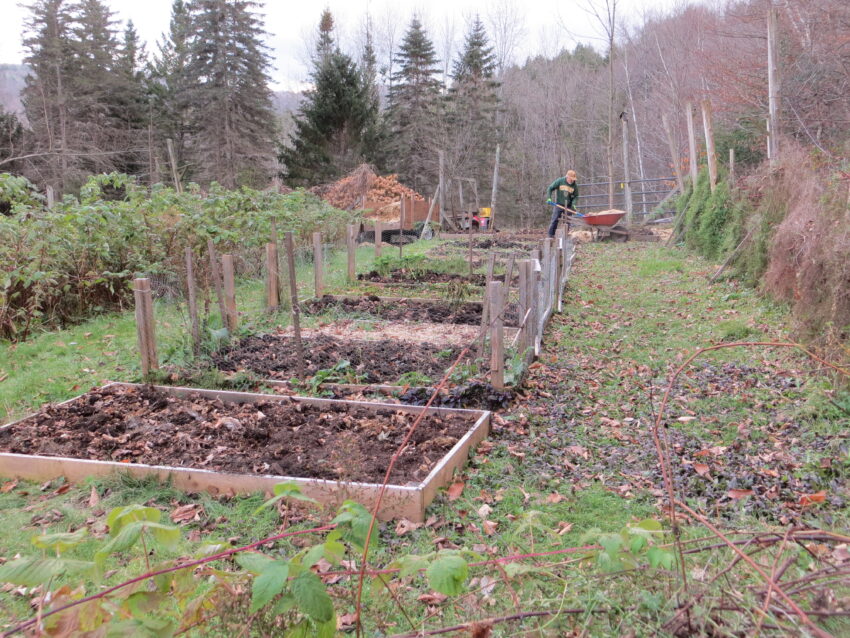
April is a pivotal month in Vermont. If you walk in the woods you still find patches of snow crouching behind rocks. Looking across the hillside I’m unsure whether I am looking at early pregnant buds on the trees or final vestiges, clinging. Budding trees create an almost alien-like wave of yellow-green, interspersed with pale reds. White birches, with their black stripes, still naked and skinny, rock back and forth in the cold breeze, like giraffes. This could be spring, or mid-fall.
Before my eyes open fully in the morning, the list begins. Making magic in the form of growing food takes thought. Every available shelf space has become a temporary indoor garden. Scrawny tomatoes waft in the breeze from our ceiling fan. Bamboo tags bear the names of each variety scrawled in black marker. Our kids’ empty bedrooms now grow onions. About once a week I go in, kneel before them and give them a good haircut with my scissors, catching the green slivers and sprinkling them into soup and on scrambled eggs.
We have packets of seeds wrapped carefully with blue rubber bands and big bags of soil waiting in our garage. Too cold for flowers, but too hard to resist, while the sun warms we drag boxes overflowing with tiny purple, white and red blooms trailing with vinca into the morning sunshine. We lift pots of Begonias and carefully place them in shaded areas of the porch. When I walk down to the barn to check animals each evening, I reverse the dragging.
Suddenly it is here.
We begin to notice projects needing to be done and scribble them on scraps of paper. The bricks of our front steps, are crooked like a teenagers teeth and need bracing. Changing the tub of water in the winter sheep paddock, I see the wire fence listing inward and make a mental note. Sheep are shorn but need a booster on their vaccinations, two chickens die and sleep next to Sam and Muir in the big compost pile at the edge of the field.
My dreams become green, and till the soil of my mind. I wake, still tired from somnolent gardening.
We see our animals change with the new light. Opening the hatch door to both coops, the chickens to spill down the ladder like children out of school for recess, a new rush in their long-nailed steps heading for the best area for grubs and worms.
The sheep doze on the straw under cover of the barn roof in the late afternoon, they, too, ruminating, waiting and watching for pasture grass to wave in the wind, indicating time to graze.
Bees begin to beard on the outside of the basil green hives: this lets me know it is time to unwrap them from the black tar paper that has encased them during the long, cold winter months. I stand near their fence and watch them lift out and up until I can’t see them anymore. They travel, beginning their search for pollen. I enjoy the proximity without my bee suit until a couple of them bang me on the side of the head, fair warning, and I step back.
Seamus, a year-old now, long and lanky, races down Magic Road with unbridled joy. Bronte trots along at the mature pace of an eleven year-old. The frisbee makes it’s appearance and Seamus quickly becomes a big fan. He springs eight feet into the air, levitating, turning to grab the yellow disc. We laugh and clap every time, surprised, delighted by the show. He lies down, humble and huffing. Again! Again!
We try to take time away, sometime in April during mud season and, on my return, I quickly call my mother to tell her about running into a childhood friend from the neighborhood we once lived in. I’m oddly excited to relate this news and am unsure why. I think it is because I feel I have found something of her past, which is the mental neighborhood in which she now resides. She laughs when I tell her but it is the forced, high-pitched laugh of someone pretending. I tell her again, and again, in a different way, hoping to hear what I am hoping to hear. She begins combining various streets and repeats the directions over and over, still laughing but not sure why. Tears fill my eyes and I change the conversation, becoming the one pretending. It is another moment of realization, perhaps acceptance.
In the warm spring evenings Seamus follows me out to the barn watching every move I make. When I step into the barn he races on the track he has created, banks and all, around the side so that he can herd the sheep from outside the fence. Once chores are finished, I open the door, whistle and he hops in onto the soft straw, silent. We work together on walking up on the sheep, lying down and “holding” our sheep with his eye. When he gets too excited, I put the palm of my hand on his chest, reminding him that I am here, there is no need to over react. He never breaks eye contact but one ear drops, an indicator of softening. I turn, he turns, and we leave the barn as quietly as we came in.
Outside, under the almost full moon, I kneel down and call to him. He runs over with a bit of a side wiggle, knowing he has done well. I take time and stroke his thin frame, telling him, over and over, “what a good boy.”
Two years ago in April, I stood outside this barn under the full moon and sobbed. Each night, over and over. We had lost Sam in March and Muir in April. I felt broken and deeply changed by the losses.
For a year and a half, although we needed one to herd, I was unwilling to even talk about another dog.
I did my chores and would stand and look down through the dark at the compost pile where Sam and Muir rested, then turn and walk back to the house followed only by memories.
Seamus arrived, as magic does, without warning but with such insistence that you heed it. My concern was that I wanted him to be the same as Muir, worried that I would always be looking for small flaws that proved the impossibility.
Seamus is not the same, couldn’t be, but, ironically, I am able to delight in his uniqueness.
I feel the thaw from within, continue to walk forward and am open to whatever the spring has to offer.
Melissa,
Your excellent writing is a balm.
David
Thank you David- I am appreciative that you read the blog and took time to respond.
Happy summer!
This really captured an April in Vermont—the indoor tomatoes under the fan, Seamus chasing the frisbee. Your mother’s part stayed with me; that shift from hoping to hearing to acceptance was honest and beautifully written. Thanks for sharing both the ground and inner thaw.
This is an important email for me- thank you. I am trying to be very honest with my writing about my feelings surrounding my mother’s illness. It is so complex and I appreciate
that you could feel that through my writing.
Thank you for taking time to both read my blog and make such an astute and kind comment.
Grateful.
Melissa