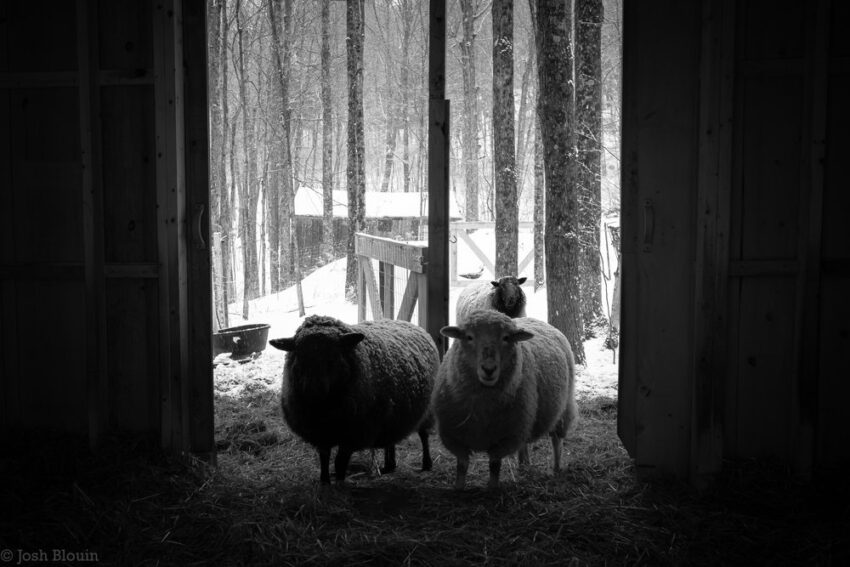
It is easy to make a plan, even a difficult plan. You wrap your head around an idea, make a call, write it in pen. When you make a difficult plan in April to be executed in October it is easy to push it to the space in your brain where cobwebs hide ideas that bloom then fade.
Accepting the idea of culling Daisy was not difficult, really. She was nine years old and had an issue with her lower spine that created issues with walking. This had been going on for more than a year but I could alleviate her pain with five small white anti inflammatory pills that I would bury in a mound of golden cracked corn each morning. Sometimes I would stop the pills, hoping each time that she would have miraculously recovered use of her leg, but when the drug level in her bloodstream dropped, she began to hobble. Each shearing Mary would, between struggles with Daisy’s great legs peddling in the air, suggest that this was the year to cull her. I’d busy myself with sweeping wool from the wood floor of the barn.
When we walked down to the pasture each morning, it wasn’t too bad. Downhill. Even Bronte, as she swung back and forth behind the sheep, knew enough to keep off her. Each evening at dusk I would walk down to the fields and see Daisy standing at the gate, waiting. When I opened the fence, the others would take off up the hill and, as sheep never want to be left behind the flock, Daisy tried joining them. She looked much like a large, white hobby horse, rear legs stiffened. When I arrived at the upper paddock Daisy would be breathing hard, her nostrils rounded. I would hear an alarm coming from the cobwebs in my brain.
Daisy was one of our original ewes. Daughter of our legendary Mrs. Chubbers, she had unfortunately inherited her mother’s wonky anatomy. She came to us a yearling in 2016 and looked straight out of a storybook; snowy white with a scrub-brush of wool on her forehead, and ears that pointed straight out each side. Each and every time I would give her bum a scratch she would wag her tail like an exuberant pup. She grew to be about one hundred seventy five pounds but never used her heft unless it meant getting a lion’s share of available cracked corn. Early on I learned to recognize her voice; a deep blat that included a noise like a light smoker’s cough. In the mornings, I would often lift the window shades to see her standing at the gate of the paddock looking back at me, waiting to be taken to breakfast.
We had to cull her mother a few years ago and I sat on the steps of the barn that evening consoling a bereft Daisy. She took careful steps into her mother’s role of lead ewe but lacked her mom’s strength of character. She was, quite simply, too sweet. However, in the fall, when apples dotted the ground of the paddocks, she would go left while Bronte and I were taking the flock right and everyone followed the leader as she steamrolled to the trees.
You get used to things; your children being small and needing you, Sam-The-Border-Collie being strong and capable of moving mountains, the familiar members of your flock. It is hard to make a difficult plan.
Farming is, maybe above all, making difficult plans. My struggle is that making life and death decisions for my animals feels above my pay grade. Sam’s legs collapsing underneath him again, and finding him at the front steps in a rain puddle, unable to get up. Mrs. Chubbers unable to eat hay because she had no back teeth, watching her bones rise from her body making her skin look like sand sliding out from the tide. Muir having a fifth seizure, climbing into my lap as I sat on the floor at midnight. Driving a wagon into the field to pick up our ewe, Charlotte, who was down with Meningeal worm, hefting her into a pile of warm straw in the barn where she would refuse to eat for three days. There are moments within these moments where my animals look up at me, so deep into me that I feel it, and they ask me to help them. The choice is difficult but clear, like their eyes.
Paul and I talked late into the night before Mary came. We felt like we were making plans but we knew we weren’t going to sleep. I watched the sky lighten through the shades and heard Daisy call me.
Mary’s truck pulled in and she climbed out. She looked at me carefully before pulling gear from the back without a word. Bronte helped push the rest of the flock behind a makeshift barrier so that they would not be able to see Daisy’s dying. Mary reassured me that she could take care of this herself if I didn’t want to stay. It was one of those difficult moments where the answer you give conflicts with the answer you feel. The decision to cull her was mine as was the decision to keep her fleece, which meant that the method of death would be different than what we had experienced before. I told her I would stay and help, she nodded.
I went out to the storage barn and got a scoop full of corn, an act so familiar that I was almost lulled into feeling normal. Outside the barn, I stood quietly and took a breath as I pulled open the door, Daisy jumped up into the barn, just like every other morning, and came over to me.
I leaned into her hind quarters while Mary held her from the front. I bent my head, as if in prayer as Mary asked me if I was ready. I took my hand and pressed it into Daisy’s fleece, feeling how deep, soft and warm she was, I nodded and closed my eyes. The bang was like the start of a race, I stepped one step back, as Mary had instructed, and Daisy fell at my feet, her eyes looking up at me.
In fifteen minutes my ewe was hanging from a hook in our barn.
I watched as Mary pulled flesh and fleece from her body, expertly using her knife to cut fat and muscle. Like a sock being turned inside out, she pulled it all off.
After laying the fleece across saw-horses, Mary went back into the barn and I smoothed salt across the still warm skin. I pushed it out to every corner with a caress. I stood and looked at where Daisy’s head and feet had been minutes before, painfully trying to put the puzzle back together. Wondering if I would remember her whole or like this. When I was finished, I could taste salt at the back of my throat, like I had been swimming in the ocean. My fingers stung and as I walked to the sunlight I held them up and understood the full ramifications of having her blood on my hands.
Her death was as humane as it could be. To let her continue to struggle would have been the cruelty. Better to decide than to find her dead in the pasture, her weakness a call to coyotes, a danger to the rest of the flock. But standing there I felt my stomach shaking and realized, with a sudden bang, the incredible fragility of life.
Yes. To let her continue to struggle would have been the cruelty.
Yes.